‘The Dog Stars’ Review: Grief and Survival in Rural Colorado
What happens when you’ve survived the end of the world, but surviving isn’t enough anymore? The Dog Stars takes the familiar post-apocalyptic story and slows it down, focusing less on the destruction of humanity and more on what remains after the destruction. It’s a beautiful, sometimes brutal film about grief, isolation, hope, and the very human need for connection. Read on for a spoiler-free review of The Dog Stars.
Screener provided by studio however, all thoughts and opinions my own. This post contains affiliate links.
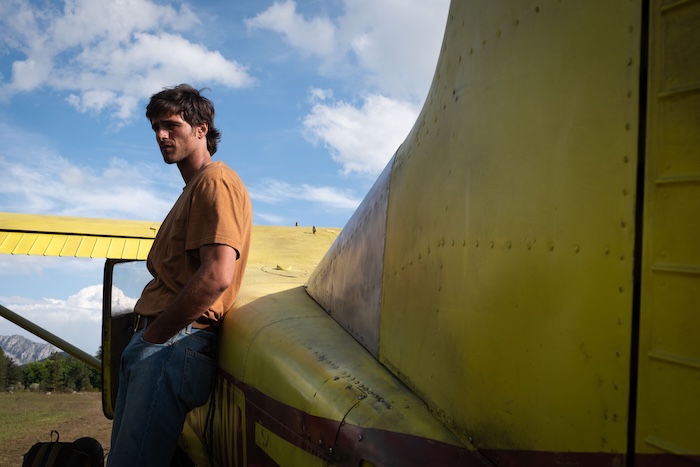
The Dog Stars is set after a devastating flu pandemic has nearly wiped out humanity and is based on the book by the same name. Hig (Jacob Elordi), a former mechanic and now pilot, lives at an abandoned airfield with his dog and Bangley (Josh Brolin), a hardened former Marine and survivalist. Hig spends his days flying over the surrounding wilderness, looking for supplies and watching for signs of other survivors. When he picks up a radio signal that suggests there may be other people out near Grand Junction, it gives him a reason to venture beyond the safety of the compound and find out what is waiting for him.
At the heart of the film is the difference between Hig and Bangley and what they believe survival actually means. Hig represents hope and a different way of living—a life not lived in fear, but in love and peace. Bangley, played by Josh Brolin, represents a much more militaristic view of survival: kill or be killed, trust no one, and do whatever it takes to stay alive. Their relationship works because neither one is completely wrong. Bangley’s diligence has kept them alive, but Hig refuses to accept that simply being alive is enough.
When Hig experiences a devastating loss, it becomes the thing that finally pushes him to leave the compound. Bangley stays behind, and the two say goodbyein their own way, knowing that Hig is heading into an unknown world. That decision is one of the most important moments in the movie because Hig isn’t leaving because he has to. He has food, weapons, transportation, and a relatively secure place to live. He leaves because he can’t give up on the possibility that there is something more than survival waiting for him.

Guy Pearce is fantastic as Pops, aka Jack, a concerned survivalist father who lives with his daughter, Seema (Margaret Qualley), in an isolated area. Hig eventually crosses paths with them, and the three find themselves facing outside threats that force them to take to the sky and discover what is waiting for them in Grand Junction. Their stories add another layer to the movie’s central question about what it means to survive and what we’re willing to risk for the possibility of connection.
The cinematography in The Dog Stars is beautiful. There are sweeping shots of Italy (doubling for Colorado) which feature rugged mountains, fast flowing rivers, and the vast wilderness surrounding the characters. These shots makes the world of The Dog Stars feel both gorgeous and incredibly lonely. The film is also lit beautifully, and even the violent scenes are carefully crafted. You can see what is happening without the camera relying on frantic cuts to hide the action. There is a real sense of quietness throughout the movie, and the landscape almost becomes another character.
The pacing is a bit slow, but that doesn’t mean The Dog Stars is boring. This is a film that takes its time letting its characters deal with grief and survival in their own ways, and those approaches often butt up against one another. I appreciated that Ridley Scott allows the story to unfold rather than rushing from one action sequence to the next.
Because there isn’t a ton of dialogue, the performances have to carry a lot of the emotional weight, and they do. Jacob Elordi puts in a strong performance as Hig, giving the character a quiet curiosity and underlying sadness. His more gentle, hopeful personality works well against Josh Brolin’s harsher and more unhinged Bangley. Guy Pearce’s strong fatherly presence also works beautifully alongside Margaret Qualley’s trusting Seema. There isn’t always a lot being said, but the actors communicate plenty through their expressions and body language, and the film visuals pick up the slack. Alison Janney is absolutely unhinged as a cunning villain and I felt the film could have benefitted from telling more of her story.
What I kept coming back to while watching The Dog Stars was Hig’s decision to leave. Why would someone walk away from a compound that has food, weapons, a plane, and everything he needs to survive for the uncertainty of the outside world? Because Hig refuses to give up hope that there is a better way of life. And that distinction is what makes the movie more interesting than a typical post-apocalyptic survival story.
Overall, The Dog Stars is a solid Ridley Scott film that asks a surprisingly human question: when your physical needs are met, what about your emotional needs? What happens when survival isn’t enough anymore? Is humanity truly destined to destroy each other, or is there still a reason to believe people can find love, community, and peace after everything has fallen apart? The Dog Stars attempts to answer those questions in a beautifully shot film about survival.